Don't Buy Until You Read This: Yamaha True X Surround 90A vs Edifier S880Db Mkii
Category: Audio
Introduction
Buying speakers or a home audio system is one of the most consequential decisions for listeners who want more than the built-in sound of TVs or laptops. Two very different approaches occupy much of the mid-range market today: compact soundbar-style solutions that prioritize simplicity and wide soundstage, and powered bookshelf/monitor speakers that emphasize fidelity, staging, and component flexibility. The Yamaha True X Surround 90A and the Edifier S880Db Mkii represent these two philosophies. This article compares them side-by-side to help buyers decide which suits their priorities: cinematic immersion and convenience, or musical accuracy and expandable desktop/stereo setups.
How buyers typically choose
Before diving into each product, it helps to outline what consumers commonly care about:
- Use case: TV and movies, gaming, music listening, or mixed use.
- Room size and placement: Living room, bedroom, desktop nearfield, or home theater.
- Connectivity and compatibility: Optical, HDMI, Bluetooth, and room-correction features.
- Sound signature: Balanced, warm, analytical, or bass-forward.
- Ease of setup and ergonomics: Single-cable simplicity vs separate amplifier/speakers.
- Value and long-term flexibility: Upgradability, replaceable components, serviceability.
With those priorities in mind, the following sections analyze the Yamaha True X Surround 90A and the Edifier S880Db Mkii across practical, real-world considerations.
Product reviews and analysis
Yamaha True X Surround 90A — Overview and use cases
The Yamaha True X Surround 90A targets listeners who want a largely plug-and-play home audio upgrade for TV-centered living. It emphasizes an immersive front-stage experience using Yamaha's proprietary virtual surround processing, designed to create a wide, enveloping image from a limited number of drivers. This approach is attractive when room layout or budget prevents installing a multi-speaker surround system.
Real-world use cases where the 90A shines:
- Small to medium living rooms where running speaker wires for a full surround system is impractical.
- Viewers prioritizing dialogue clarity for TV shows and movies, with a focus on simplified control.
- Gamers who prefer a single front-stage solution that delivers positional cues without an elaborate setup.
Strengths to expect in practice include an expanded stereo image, easy integration with modern TVs via digital inputs, and a design geared toward conversational clarity and cinematic presentation. Because it is engineered to simulate surround effects, it can make two-channel sources feel wider and more spacious than many basic soundbars.
Edifier S880Db Mkii — Overview and use cases
The Edifier S880Db Mkii is positioned as a powered bookshelf/studio-oriented speaker package aimed at listeners who value fidelity, neutral-to-warm tonal balance, and flexible inputs. It is likely to appeal to people who want better music reproduction, desktop nearfield listening, or a two-channel setup that can be expanded with a subwoofer if desired.
Real-world use cases where the S880Db Mkii excels:
- Desktop listening for music production, mixing, or focused enjoyment where nearfield clarity matters.
- Small living rooms or bedrooms where two well-positioned powered speakers can produce accurate imaging.
- Users who want a direct digital connection from a computer, streamer, or DAC and appreciate physical controls and connectivity options.
In practice, a powered bookshelf solution like this tends to produce tighter, more articulate midrange and better stereo imaging for music compared with most single-chassis soundbars. It also gives buyers the ability to place speakers independently for improved soundstage control.
Find top-rated Audio & Headphones products at great prices.
Shop Amazon →In-depth sound and performance comparison
The most consequential difference between the two systems is their sonic philosophy.
Soundstage and imaging
The Yamaha's virtual surround processing aims to create a broad, enveloping soundstage from a single front element. For movie soundtracks and broadcast content, this can enhance spatial cues and produce the sensation of sounds coming from beyond the screen. However, the effect depends heavily on room acoustics, listening position, and placement of the unit relative to walls.
The Edifier S880Db Mkii, as a two-speaker solution, should provide more precise stereo imaging when the listener sits in the sweet spot. For nearfield music listening, the separation between left and right cabinets typically yields superior instrument placement and front-to-back depth compared with virtual surround approaches.
Tonal balance and dialogue
Yamaha systems often emphasize vocal clarity and a slightly forward midrange to keep dialogue intelligible for TV and movies. The True X Surround 90A is expected to keep speech prominent without excessive brightness, but some listeners may perceive a mild coloration intended to enhance presence.
The Edifier package generally aims for a more neutral or slightly warm presentation, favoring clarity and detail resolution in the midrange. Music listeners and critical listeners often prefer this tuning, while casual movie viewers may miss the theatrical emphasis on dialogue and effects found in soundbar processing.
Bass performance
Because of physical constraints, soundbars typically rely on internal or external subwoofers to deliver the lowest frequencies. The Yamaha solution may include a built-in low-frequency driver or pair with a wireless subwoofer to produce cinematic impact. Expect stronger low-frequency extension when paired with an external subwoofer, but localized bass and visceral impact depend on the sub's size and placement.
Bookshelf powered speakers like the Edifier S880Db Mkii can produce controlled, tight bass for nearfield listening but will not match the extension of a large subwoofer. For music and precise bass reproduction, the Edifier approach often yields cleaner bass that is easier to integrate in-room without overwhelming the midrange.
Connectivity and features
Yamaha systems prioritize TV-friendly inputs (HDMI ARC/eARC, optical, and Bluetooth) and may include room-correction presets or DSP modes for movies, music, and gaming. This makes them convenient as a living-room centerpiece where the primary source is a TV.
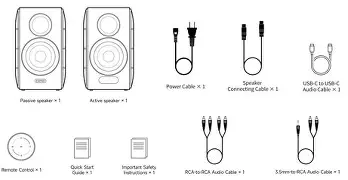
Edifier powered speakers typically offer a mix of digital and analog inputs—USB or coaxial/optical for direct connection to a computer or streamer, RCA for analog sources, and Bluetooth for convenience. They often include onboard volume and tone controls and sometimes a remote, giving desktop and stereo users fine-grained control.
Looking for the best Audio & Headphones deals on Amazon?
View Offers →Build, ergonomics, and practical considerations
Soundbars are often designed to be low-profile and sit under or mount to a TV. The Yamaha is likely compact, cosmetically neutral, and easy to conceal. This reduces clutter and simplifies cable runs.
The Edifier S880Db Mkii will have two distinct cabinets, which requires planning for speaker placement and stands or isolation pads. Powered speakers remove the need for a separate amplifier, but they do require two connection points and more physical space than a single soundbar.
Pros & Cons
Yamaha True X Surround 90A
- Pros:
- Designed for TV-first use—simple setup and fewer cables.
- Virtual surround processing expands the perceived soundstage for movies and TV.
- Likely includes TV-friendly inputs and DSP modes for dialogue, movies, and gaming.
- Space-saving form factor suitable for wall-mount or shelf placement.
- Cons:
- Virtual surround effects are room-dependent and may sound artificial to some listeners.
- Limited physical bass output compared with a full-size subwoofer unless paired with one.
- Less flexible for future upgrades if the user wants discrete multi-channel speakers.
Edifier S880Db Mkii
- Pros:
- Two-channel powered setup yields precise stereo imaging and musical clarity.
- Flexible digital and analog connectivity for computers, streamers, and sources.
- Powered speakers remove the need for an external amplifier while delivering refined tonal balance.
- Easier to integrate with audio workflows and nearfield listening setups.
- Cons:
- Requires more room planning and speaker placement for optimal imaging.
- May lack the cinematic "envelopment" of a dedicated multi-channel system without a subwoofer or external processing.
- Fewer purely TV-focused conveniences like HDMI ARC in some configurations (depending on exact model feature set).
Comparison table
| Attribute | Yamaha True X Surround 90A | Edifier S880Db Mkii |
|---|---|---|
| Product type | Single-unit soundbar with virtual surround | Powered bookshelf/monitor speakers (stereo pair) |
| Best for | TV/movies, gaming, easy living-room upgrades | Music, desktop/stereo listening, nearfield accuracy |
| Sound signature | Movie-forward, enhanced dialogue and spaciousness | Neutral to warm, detail-oriented midrange |
| Connectivity | TV-centric inputs (digital/HDMI/Bluetooth) | Digital and analog inputs, Bluetooth, USB/optical (model-dependent) |
| Bass handling | Engineered for punch with optional subwoofer pairing | Tight, controlled bass; subwoofer recommended for deep extension |
| Placement flexibility | Single placement under TV; mounts to wall | Requires two placements; benefits from stands or isolation pads |
| Ease of setup | Very easy—single component, fewer cables | Moderate—powered speakers are simpler than separates but require placement |
| Upgrade path | Limited—focused on integrated ecosystem or subwoofer add-on | Good—speakers can be paired with external DACs, preamps, and subwoofers |
| Recommended room size | Small to medium living rooms | Small to medium rooms; excellent for desktop and nearfield use |
Buying guide: how to choose between them
Choosing between the Yamaha True X Surround 90A and the Edifier S880Db Mkii largely comes down to priorities and physical constraints. The following checklist helps match needs to strengths.
Ask these questions first
- What will be the primary use? If the main activity is TV and movies, a soundbar with virtual surround often delivers more immediate cinematic satisfaction. If music listening or critical nearfield listening is primary, powered bookshelf speakers typically provide superior fidelity.
- Where will the system sit? If space is tight and a single low-profile unit is required, the Yamaha soundbar is the obvious choice. If there is room for two speakers and the listener can place them symmetrically around the listening position, Edifier will reward that investment.
- Does the user plan to expand later? Those who want to build a modular stereo rig, add a high-quality DAC, or integrate a subwoofer later may prefer the Edifier approach. Buyers focused on simplicity and a tidy living-room setup may favor Yamaha.
- How important is simple TV integration? If HDMI ARC/eARC and single-remote control are priorities, check the Yamaha's compatibility with the TV's audio return features. For computer-centric use with USB or optical connections, the Edifier may be easier to integrate.
- Is room correction or DSP desirable? Some Yamaha products include room presets or virtual-surround DSP modes that help adapt to different room shapes. The Edifier path usually emphasizes minimal DSP for purer sound, though some models include tone controls or presets.
Practical buying tips
- Listen before buying when possible. A demo in a similar-sized room or a trusted retailer will reveal how each system interacts with real room acoustics.
- Consider adding a subwoofer if heavy action movies or electronic music with deep bass are important. Both systems benefit from a well-integrated sub for low-frequency impact.
- Prioritize connectivity based on sources: ensure the chosen model supports the user's TV, console, streamer, or computer without awkward adapters.
- Think about ergonomics—remote control, onboard volume, and preset switching matter for day-to-day use, especially for TV setups.
- Factor in placement accessories: stands, isolation pads, or wall mounts can materially improve the performance of bookshelf speakers and soundbars respectively.
Value and long-term considerations
Value isn't only about the initial purchase price; it includes how well the product fits the intended use and whether it will remain satisfying over time. The Yamaha soundbar may offer immediate “wow” for film lovers and gamers with minimal setup, delivering a strong return for living-room-centric buyers. The Edifier S880Db Mkii tends to serve listeners who care about music quality and the flexibility to upgrade individual components over time.

Serviceability and support are also considerations: powered speakers with active electronics may require different support than a simple soundbar. Buyers should check warranty terms and local support channels when making a decision.
Conclusion
Both the Yamaha True X Surround 90A and the Edifier S880Db Mkii bring compelling strengths to different buyers. The Yamaha is an attractive, convenient choice for people who want enhanced movie and TV sound without complicated wiring or a large footprint. Its virtual surround processing and TV-focused features make it an excellent living-room upgrade.
The Edifier S880Db Mkii is better suited to listeners who prioritize musical accuracy, stereo imaging, and flexible integration with computers and dedicated audio sources. Its powered bookshelf format rewards careful placement and suits those who want a modular path for upgrades.
Ultimately, the right purchase depends on priorities: choose the Yamaha for simplicity and cinematic presence; choose the Edifier for fidelity, placement control, and a more traditional stereo listening experience. Listening to each in an environment similar to the intended use case remains the best way to confirm which system will satisfy the individual listener’s expectations.