Spec Battle: Msi Titan 18 Hx 2025 vs Msi Cubi Nuc 1M — Is It Worth Upgrading?
Category: Laptops
When buyers consider upgrading hardware in 2025, they are often split between two very different directions: a flagship, desktop-replacing gaming laptop or a compact mini-PC that covers everyday productivity with minimal footprint. This comparison pits the MSI Titan 18 Hx 2025 — an 18-inch, HX-class performance laptop aimed at gamers and creators — against the MSI Cubi Nuc 1M — a compact, energy-efficient mini-PC designed for space-conscious users and light workloads. The goal is practical: help readers decide whether upgrading to either device makes sense for their real-world needs.
Introduction
Spec battles can be misleading if they focus strictly on headline numbers. In practice, buyers care about how hardware behaves in use: thermals under sustained load, battery life away from the outlet, upgrade paths, noise, reliability, and the total cost of ownership for the workflows they run. The two machines compared here occupy distinct niches: one prioritizes top-end performance and an immersive screen, the other prioritizes small size, low power draw, and quiet operation. This article walks through their intended roles, practical performance expectations, pros and cons, and a clear buying guide so readers can match hardware to real-world priorities.
At a glance: what each product aims to be
MSI Titan 18 Hx 2025 is presented as a desktop-replacement laptop built for demanding tasks: high-refresh gaming, 3D rendering, video editing, and streaming. It targets users who want near-desktop performance in a single, portable chassis — albeit a large and heavy one. Expect aggressive cooling, high-power mobile CPUs (HX-class) and discrete GPUs, and an 18-inch display with gamer-friendly refresh rates.
MSI Cubi Nuc 1M is focused on compactness and efficiency. It is intended for everyday office work, web browsing, media playback, and use as a small home server, digital signage box, or simple content-creation companion. The Cubi Nuc 1M prioritizes low power, small size, and quiet operation rather than raw gaming throughput.
Detailed product review and analysis
Design and build
The Titan 18 Hx 2025 continues the trend of full-size gaming laptops that do not compromise on cooling or I/O. It is physically large, with a thick chassis to house multiple heat pipes, vapor chambers, and a robust keyboard deck. The 18-inch screen provides a large workspace for editors and an immersive field of view for games. The weight and footprint mean it is not ideal for daily commuting but acceptable for occasional travel where a single high-performance machine is preferred.
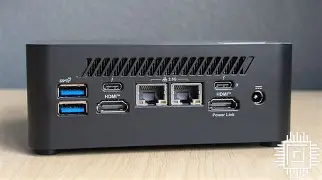
The Cubi Nuc 1M is intentionally minimal: a small box that can tuck behind a monitor or be VESA-mounted. Build materials skew toward functional plastic or metal depending on configuration, and the chassis is optimized for passive or low-speed fan cooling. This reduces noise and power draw, and it makes the device unobtrusive in shared workspaces or home theaters.
Performance
Raw compute advantage goes to the Titan. Equipped with HX-series mobile CPUs and high-performance discrete GPUs in typical configurations, it crushes single-box workloads that need GPU acceleration and high single-thread clocks. For content creators who render video on the timeline, run GPU-accelerated effects, or compile large projects, that extra headroom translates into real time savings.
In contrast, the Cubi Nuc 1M is built around low-power consumer processors (often in the Intel N- or U-class or comparable low-power chips) and either integrated graphics or a small discrete option on some SKUs. It handles office suites, browsers with many tabs, 1080p media playback, light photo editing, and coding well, but it will struggle or be very slow for demanding 3D workloads and modern AAA gaming at high fidelity.
Display and multimedia
The Titan’s 18-inch panel is a major selling point: larger workspace, higher refresh rates (often 120Hz, 165Hz, or more on gaming models), and color options that can be tuned for creative work (wide gamut, higher brightness and factory calibration on some SKUs). This makes it suitable as both a gaming machine and a portable editing workstation.
The Cubi Nuc 1M relies on external displays and thus offers flexibility: connect a 4K monitor or a multi-display setup. The quality then depends on the chosen monitor, which is beneficial for buyers who already own screens and want a small, silent box as the brains behind them.
Thermals, noise, and battery
Thermals for the Titan are engineered to sustain high clocks for longer, but that comes with tradeoffs: fans can become loud under load, and battery life is typically modest when running heavy applications. For gamers or creators who frequently work plugged in, the trade is acceptable; for someone wanting long unplugged use, the Titan is not optimized.
Shop the latest Laptops & Computers picks on Amazon.
Browse Now →The Cubi Nuc 1M wins on noise and power efficiency. It runs quietly and uses much less electricity. There is no internal battery (or it is very small if included for short UPS-like holdovers), so this is a device meant to stay plugged in and serve reliably with minimal running costs.
Ports and connectivity
The Titan generally provides a generous selection: multiple USB-A and USB-C ports (often with Thunderbolt support on Intel models), HDMI, mini-DisplayPort or full-size DisplayPort via USB-C, Ethernet, and audio jacks. This versatility is useful for streamers, creators, and gamers who attach capture cards, multiple drives, and external displays.
The Cubi Nuc 1M packs essential I/O for its size: USB ports, HDMI or DisplayPort, gigabit Ethernet (often standard), and occasionally a built-in SD or microSD reader. Expansion options are fewer but adequate for workplace setups or home media centers.
Upgradeability and serviceability
High-end gaming laptops like the Titan increasingly allow upgrades for RAM and storage. The HX-class designs sometimes permit GPU upgrades only via external eGPU docks; internal GPU swaps are not feasible. Repairability varies across models but is better than most thin-and-light laptops because of the larger chassis.
The Cubi Nuc 1M typically provides user-accessible slots for M.2 NVMe SSDs and SO-DIMM RAM, making it straightforward to expand storage and memory. Its modular nature can be attractive for users who want to upgrade incrementally without replacing the entire system.
Comparison table
| Aspect | MSI Titan 18 Hx 2025 | MSI Cubi Nuc 1M |
|---|---|---|
| Product type | High-performance gaming / creator laptop (desktop replacement) | Compact mini-PC (space- and power-efficient) |
| Typical CPU | HX-class high-power mobile CPUs (multi-core, high TDP) | Low-power consumer CPUs (U-/N-class or efficient Intel/AMD chips) |
| Graphics | Discrete GPUs (mobile RTX/AMD equivalents) for gaming and GPU compute | Integrated graphics; occasional low-power discrete options |
| Display | 18" high-refresh, high-brightness options | Uses external monitor(s); supports up to 4K via DisplayPort/HDMI |
| Portability | Bulky and heavy; portable for short trips | Extremely compact; easy to move and mount |
| Thermals & Noise | Strong cooling, can get loud under load | Quiet operation, low heat output |
| Upgradeability | RAM/storage upgrades common; GPU usually fixed | RAM and NVMe upgrades typically user-accessible |
| Battery | Internal battery with modest runtime under load | No battery — designed to run plugged in |
| Best for | Gamers, video editors, 3D artists who need mobility with power | Office workers, HTPC, light creators, kiosk or digital signage |
| Price range (typical) | Premium — higher entry price for top configs | Budget to mid-range depending on CPU and RAM |
Pros & Cons
MSI Titan 18 Hx 2025
- Pros: Exceptional performance for gaming and content creation; large, high-refresh display; robust cooling designed for sustained loads; extensive I/O for peripherals and external storage.
- Cons: Heavy and less convenient for daily commuting; louder fans under heavy use; battery life is limited when running intensive tasks; high cost for top configurations.
MSI Cubi Nuc 1M
- Pros: Compact and unobtrusive; low power draw and quiet operation; easy to place in small spaces or behind a monitor; typically more affordable; user-upgradeable RAM and storage.
- Cons: Not suitable for heavy gaming or GPU-accelerated workloads; reliant on external display(s); limited internal expansion for high-performance upgrades.
Real-world use cases: who should consider each?
Choose the MSI Titan 18 Hx 2025 if:
- Gaming at high settings or high refresh rates is a priority, and the user needs a single machine for play and content creation.
- Video editors, 3D artists, and streamers want a portable workstation that can be used for demanding timelines, rendering previews, and live captures without sacrificing performance.
- Users prefer an all-in-one device with an integrated large screen and don’t mind trading weight and battery life for performance.
Choose the MSI Cubi Nuc 1M if:
- Space is limited — for example, a small home office, classroom, or public kiosk where silence and a small footprint are important.
- Workloads are light to moderate: productivity apps, web conferencing, media consumption, coding, or running a lightweight server at home.
- Cost control, low power consumption, and quiet operation are higher priorities than peak compute or gaming performance.
Buying guide: considerations before upgrading
When deciding whether to upgrade, buyers should weigh these practical factors rather than chasing raw specs alone.
1. Define the primary workload
Is the main task gaming, video editing, CAD, or office productivity? For GPU-accelerated creative workloads and modern AAA games, a Titan-class laptop provides measurable benefits. For email, documents, spreadsheets, and streaming video, a Cubi-class mini-PC is more than sufficient and more economical.
2. Mobility vs. permanence
If the device needs to move between home and office frequently, weight and battery life matter. The Titan is portable in the sense that it can be carried, but it is not a daily commuter laptop for many users. The Cubi Nuc 1M is designed to stay put — portability in its case means it is easy to move and tuck away rather than run on battery.
3. Display and workspace
The Titan’s big built-in display provides a large work area without buying extra monitors. If a user already owns high-quality external displays, the Cubi allows leveraging those screens while keeping a tiny system out of the way.
Discover deals on Laptops & Computers — updated daily.
Shop Amazon →4. Noise and environment
Shared spaces benefit from quiet hardware. The Titan’s fans can become intrusive during long renders or gaming sessions, while the Cubi excels in noise-sensitive environments.
5. Upgrade path and longevity
RAM and storage upgrades extend the life of both devices, but the Cubi often makes upgrades easier and cheaper. The Titan’s higher baseline performance may remain relevant longer for demanding apps, but higher initial cost and heat-related wear are considerations.
6. Budget and total cost of ownership
Consider not just the purchase price but power usage and any additional purchases: external displays, keyboards, cooling pads, or docking stations. The Titan’s higher power draw will increase electricity costs under heavy daily usage. The Cubi’s efficiency keeps running costs low.
7. Repairability and support
Check service plans and warranty options. Larger laptops tend to have more parts and complex cooling systems that could be costlier to repair. Mini-PCs are simpler and often cheaper to service or replace individual components like SSDs or RAM.

Practical upgrade scenarios
Here are a few upgrade scenarios to help frame the decision:
- From a thin-and-light laptop to a single power machine: Upgrading to the MSI Titan makes sense if the current laptop fails to handle long rendering times, modern AAA games, or multitasking with GPU workloads.
- From an aging desktop or bulky tower: If a user values space savings without needing high-end GPU power, the Cubi Nuc 1M can replace a basic tower for office tasks and media while freeing up desk room.
- Small business or classroom deployment: The Cubi’s compact form factor, low noise, and low power consumption often make it the better fleet choice for many institutions.
- Content creator who travels occasionally: The Titan may be the right balance: it provides near-desktop performance without maintaining a separate desktop at home, assuming occasional travel is acceptable.
Final verdict — is it worth upgrading?
Upgrading is worth it when the new device eliminates a daily pain point. For users who feel limited by long render times, low frame rates in modern games, or insufficient GPU acceleration in creative apps, the MSI Titan 18 Hx 2025 represents a meaningful upgrade: it will reduce task time and enable workflows that were previously impractical on lighter hardware. The caveat is that the user must accept the size, noise, and higher price that come with those gains.
For buyers whose pain points are cluttered desks, slow boot times for simple tasks, or wanting a quiet machine that can be left on 24/7 to serve files, host light services, or power a single- or dual-monitor workstation, the MSI Cubi Nuc 1M is the more sensible upgrade. It delivers solid day-to-day responsiveness and keeps running costs low without the bulk or noise of a high-power laptop.
In short: upgrade to the Titan if raw portable power is required; upgrade to the Cubi Nuc 1M if compactness, quiet operation, and cost-efficiency are the priority. Each device is optimized for different user needs, and the "worth" of an upgrade depends entirely on which of those needs is most pressing.
Conclusion
Both the MSI Titan 18 Hx 2025 and the MSI Cubi Nuc 1M have clear, complementary roles. The Titan targets users who demand high performance in a single portable chassis and are prepared to trade weight and battery life for speed. The Cubi Nuc 1M serves users who prioritize small size, quiet operation, and low power consumption for everyday computing. Prospective buyers should match device characteristics to their workloads, workspace constraints, and budget to determine if an upgrade is justified. When the machine aligns with those priorities, the upgrade will feel like a meaningful improvement rather than an expensive status change.